
RIL, however, remains miles ahead of TCS in other financial parameters such as total revenue, operating profit, net worth, assets, and market capitalisation.

Corporate revenues will decline for a third consecutive quarter in March on a YoY basis - one of the worst shows by these companies in many years.

Indians face COVID-19 with record debt, stalled income.

The spread of COVID-19 and the accompanying mayhem caused the S&P BSE Sensex to drop over 38.5 per cent from its all-time high of 42,273.9 to a low of 25,981.2 on March 23. Those in the astrology and even numerology segments received more calls than before during the time.

Profitability and cash reserves have halved since the global financial crisis.

The combined market capitalisation of the top 873 family-owned companies was down 26.3 per cent year-on-year (YoY) to Rs 61.8 trillion at the end of trading on Tuesday. It had grown 6 per cent in FY19 and nearly 20 per cent in FY18.
Some of the top indebted companies likely to face financial headwinds in the coming quarters include NTPC, PowerGrid, Tata Steel, Adani Power, JSW Steel, UPL, and Steel Authority of India. Together these 201 companies owed Rs 14.9 trillion to their lenders at the end of September 30, 2019, up 4.1 per cent year-on-year (YoY) during the first half of FY20.

In the manufacturing sector, output is expected to decline by about 70 per cent as only food-processing, and drugs and pharma industries are allowed to operate while other segments, such as engineering and metals, have shut operations.

The bank was worth over Rs 80,000 crore as recently as September 2017. The lender had grown at breakneck speed, helped perhaps by Rana Kapoor's reputation as a banker, willing to aggressively write checks.

Mumbai saw an average 46 per cent decline in congestion during the morning rush hour on Tuesday. New Delhi's data also showed an average 34 per cent decline in congestion during morning.

Vodafone Idea's net worth (or shareholders' equity) was down 73 per cent year-on-year to around Rs 17,600 crore at the end of the December 2019 quarter after the company reported a net loss of around Rs 6,400 crore during the quarter. Cumulatively, the company has lost nearly Rs 45,000 crore in the last four quarters, eroding its net worth to its lowest level in three-year. Analysts said a such a low level of net worth, coupled with continuing losses in operations, ruled out the possibility of the company getting fresh loans from lenders to fund its adjusted gross revenue (AGR) dues of Rs 54,000 crore.
Dividend distribution tax in FY20 would only be applicable after deducting Rs 70 received from the foreign subsidiary, meaning 20.56 per cent DDT would be paid only on Rs 30.

An analysis of S&P BSE 500 companies suggests that promoters of Indian private-sector companies in particular could end up paying at least 20 per cent more as additional tax on the same dividend income.

Reports suggested that stock market regulator, the Securities and Exchange Board of India (Sebi), is looking into the allegations of insider trading in the shares of Aptech, a computer training company in which Jhunjhunwala is a promoter. An email sent to Jhunjhunwala on the allegations did not immediately receive a response.

Net sales growth for the quarter ended December (Q3FY20) was 4.5 per cent on a year-on-year (YoY) basis for companies that have declared their results so far, compared to an 8.4 per cent rise in the first half of the financial year. This indicates that there could be a further rise in days' sales of inventory.

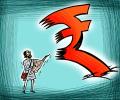
The Indian rupee is down nearly 2 per cent against the US dollar since the beginning of January 2019. Experts attribute the Indian rupee's relatively poor performance to a sharper-than-expected fall in economic growth in India.

The country's top FMCG stocks, such as Hindustan Unilever, ITC, Nestl, Britannia, Godrej Consumer Products, and Dabur, among others, are currently trading at around 41x their trailing 12-month earnings, down from their peak P/E multiple of around 48x at the end of December 2018.

This is the biggest equity-raising exercise by an Indian corporate within a financial year. The fundraising - led by Citibank, Goldman, Kotak and Axis Capital as bankers - will see participation by foreign and domestic institutional investors.

Richest 10 account for 41% of promoter wealth, up from 33% in December 2018, says Krishna Kant.

The Sensex is on course to ending calendar year (CY) 2019 at a price-earnings (P/E) multiple of 29x, the highest in 25 years. Current valuations are, however, lower than those seen in the early 1990s. The Sensex has risen close to 14 per cent in the last 12 months, while the index underlying EPS dropped 6.7 per cent during the period.
 © 2026 Rediff.com - Advertise with us - Disclaimer - Privacy Policy - Sitemap - Feedback - About us - Terms of use - Grievances